
Esther Bible Story: For Such a Time as This
Esther Bible Story: For Such a Time as This
A young queen, a hidden identity, and the courage to stand when silence would have been safer.

👉 Listen to the Audio Podcast here 👈
She stood near the entrance of the king's court with royal robes on her shoulders and death hanging in the air.
One step forward could save her people. One wrong move could end her life.
Her name was Esther. Before she wore a crown, she was Hadassah, a Jewish orphan raised far from the land of her ancestors. And now, inside the palace of Persia, the fate of her people rested on whether she stayed silent or spoke.
"And who knows but that you have come to your royal position for such a time as this?" — Esther 4:14
Esther's story is found in the Book of Esther, the seventeenth book of the Old Testament in most Protestant and Catholic Bibles.
It is one of the most dramatic accounts in Scripture. A king with unchecked power. A queen removed from her throne. A hidden Jewish girl raised into royalty. An official consumed by hatred. A death sentence sealed into law. And one woman forced to decide whether her position was for comfort or for calling.

The Empire That Held Her People
The story unfolds in the Persian Empire under King Ahasuerus, also known as Xerxes.
This was no minor kingdom. It spanned 127 provinces, stretching from India to Cush. A royal decree could travel like thunder across the land, lifting a person to honor or condemning an entire people in a single stroke.
The Jewish people lived scattered throughout this empire in exile. Some had returned to Jerusalem, but many remained in Persia, a minority surviving under the shadow of a kingdom that did not share their covenant, their worship, or their story.
Esther was one of them.
But before Esther ever entered the palace, another queen stood at the center of a different storm.
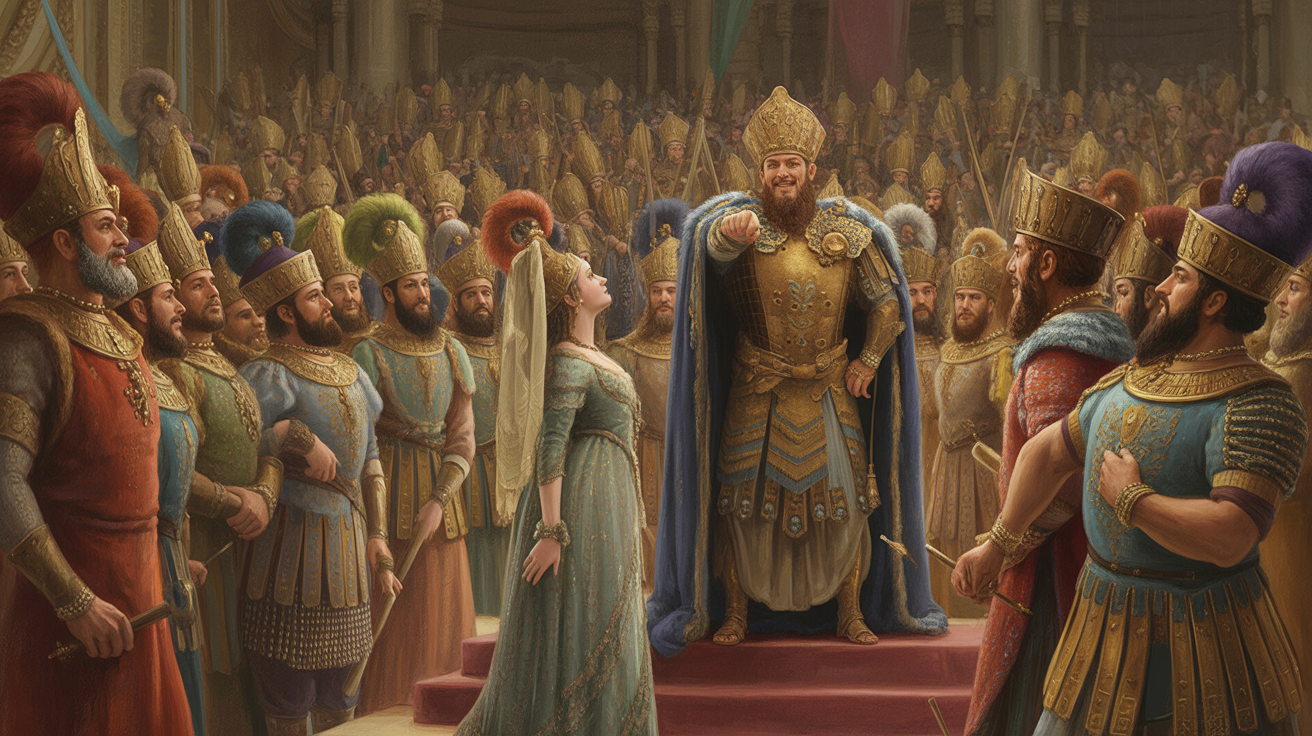
Queen Vashti's refusal opened an unexpected door in the palace of Persia.
Vashti Refuses the King
King Ahasuerus staged a massive display of his wealth and power, lasting 180 days, followed by a seven-day banquet in Susa filled with wine, nobles, officials, and imperial pride.
At the height of the feast, he commanded Queen Vashti to appear before his guests and display her beauty.
Vashti refused.
Scripture does not detail every motive behind her refusal, but it tells us the result. Her defiance enraged the king. His advisers feared her example would spread through the empire, so Vashti was stripped of her royal position.
A crown was removed from one woman, leaving an unexpected vacancy in the palace.
No one in Persia could have known that this political crisis would become the very doorway through which God would preserve His people.

Hadassah, raised by her cousin Mordecai, entered the palace carrying a secret she could not reveal.
Hadassah Enters the Palace
A search began for a new queen.
Young women from across the empire were gathered into the palace, among them a Jewish girl named Hadassah, also known as Esther. She had no living father or mother. Her cousin Mordecai had raised her as his own daughter.
Esther did not enter the palace carrying power. She entered carrying vulnerability.
She was young, Jewish, and living in exile. Mordecai gave her one command that reveals just how dangerous her situation was: do not reveal your people or your family background.
So Esther carried a hidden identity into the very heart of Persia.
She learned the customs of the court. She lived among strangers. She watched, listened, and moved with wisdom. Scripture tells us she found favor with everyone she met.
When her turn came to stand before the king, Ahasuerus loved Esther more than all the other women. He set the royal crown on her head and made her queen in Vashti's place.
The orphan became queen.
But the secret remained.
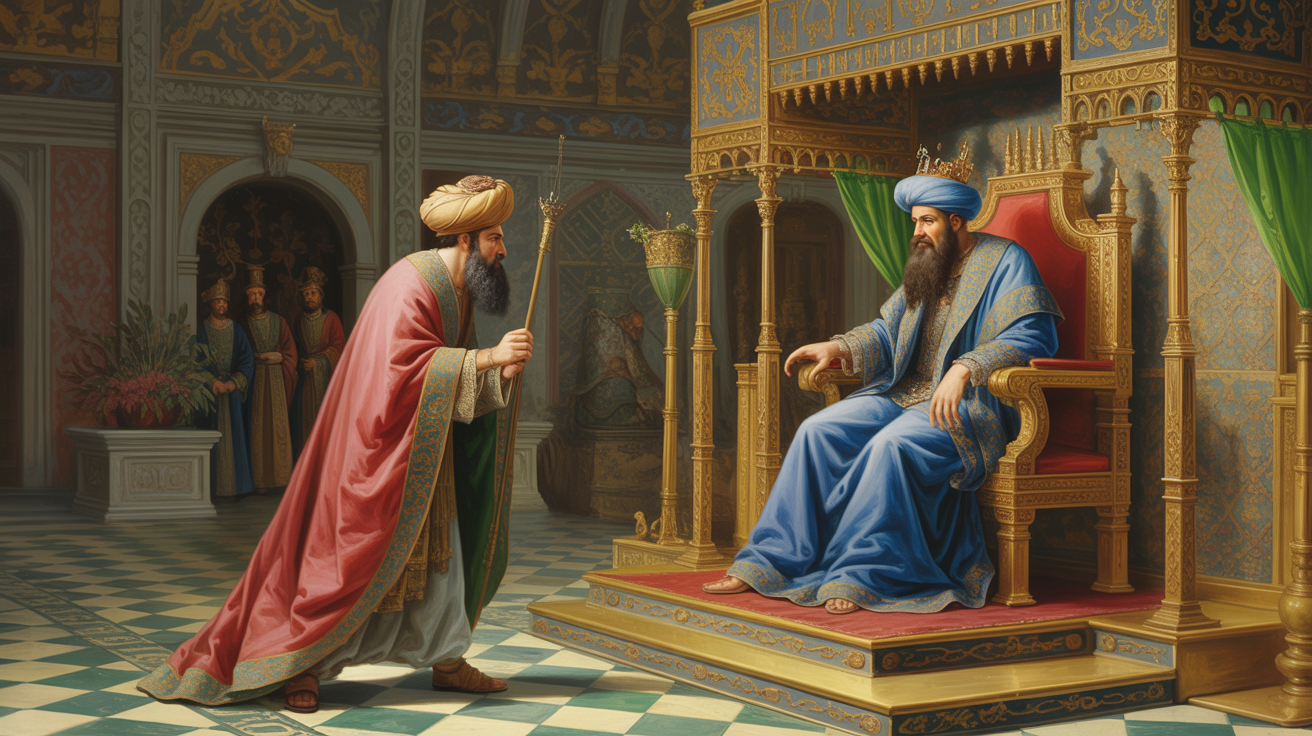
Mordecai's faithfulness at the king's gate would later prove to matter more than anyone realized.
Mordecai at the King's Gate
While Esther lived inside the palace, Mordecai stayed near the king's gate.
There he overheard a conspiracy against the king's life. Two of the king's officers were plotting to harm Ahasuerus. Mordecai reported the plot through Esther, and the king was spared.
The event was recorded in the royal chronicles.
But Mordecai was not honored for it. For the moment, it seemed forgotten.
That detail matters. In the Book of Esther, nothing is wasted. The forgotten record, the sleepless night still to come, the delayed honor, the hidden identity, the timing of every feast — all of it moves like unseen threads beneath the surface of the story.
God's name is never written openly in the Book of Esther, yet His providence is woven through every page.
Haman's Hatred Rises
Then Haman rose to power.
An Agagite promoted above every other official in the kingdom, Haman was given a command from the king: all royal officials were to bow and pay him honor.
Mordecai would not bow.
Day after day, the officials at the gate bent low before Haman while Mordecai stood firm. Scripture makes clear his refusal was tied directly to his identity as a Jew.
Haman's fury could not be contained by Mordecai alone. When he learned Mordecai was Jewish, he set out to destroy every Jew throughout the entire kingdom of Ahasuerus.
What began as a personal insult became a death sentence for an entire people.

Haman dressed his hatred in the language of loyalty and convinced the king to seal a death decree.
The Decree of Death
Haman cast lots, called pur, to determine the day for his plan. The lot fell on the thirteenth day of the twelfth month, the month of Adar.
He then approached the king with carefully chosen words, claiming there was a people scattered through the provinces whose customs set them apart and who did not keep the king's laws.
He dressed up hatred as loyalty. He made genocide sound like sound government policy.
The king gave him authority. The royal signet ring was placed in Haman's hand, and a decree was written and sealed: on a single appointed day, the Jews were to be destroyed, killed, and annihilated — young and old, women and children — and their property seized as plunder.
Couriers carried the law swiftly across the empire, and the city of Susa was thrown into confusion.

Mordecai's grief poured into the streets the moment the decree against his people was sealed.
Mordecai Mourns in Sackcloth
When Mordecai learned what had been decreed, he tore his clothes and dressed in sackcloth and ashes.
He went out into the city crying with a loud and bitter cry. This was not quiet grief. It was mourning with dust ground into the skin — the sound of a man watching the destruction of his people written into law.
When Esther heard of Mordecai's mourning, she was deeply distressed. She sent him clothing, but he refused it. So she sent Hathach, one of the king's eunuchs, to learn what had happened.
Mordecai told him everything and gave him a copy of the decree, commanding Esther to go before the king, beg for mercy, and plead for her people.
But Esther understood the danger this carried.
The Cost of Approaching the King
No one could enter the king's inner court uninvited. Man or woman, the law made no exception. Unless the king extended his golden scepter, the penalty was death.
And Esther had not been summoned to the king in thirty days.
This was no small request. Mordecai was asking her to walk willingly toward execution, to reveal the secret she had guarded since entering the palace, and to identify herself openly with a condemned people.
From the outside, Esther looked safe. She had a crown, royal robes, and palace walls surrounding her.
But Mordecai saw the truth.
"Do not think that because you are in the king's house you alone of all the Jews will escape." — Esther 4:13
Then came the words that have echoed across generations.
"And who knows but that you have come to your royal position for such a time as this?" — Esther 4:14
That sentence was no slogan for comfort. It was a summons to risk.
Mordecai was telling Esther that her position was no accident — that her crown was not merely personal blessing, but influence entrusted to her for a moment that would demand courage.
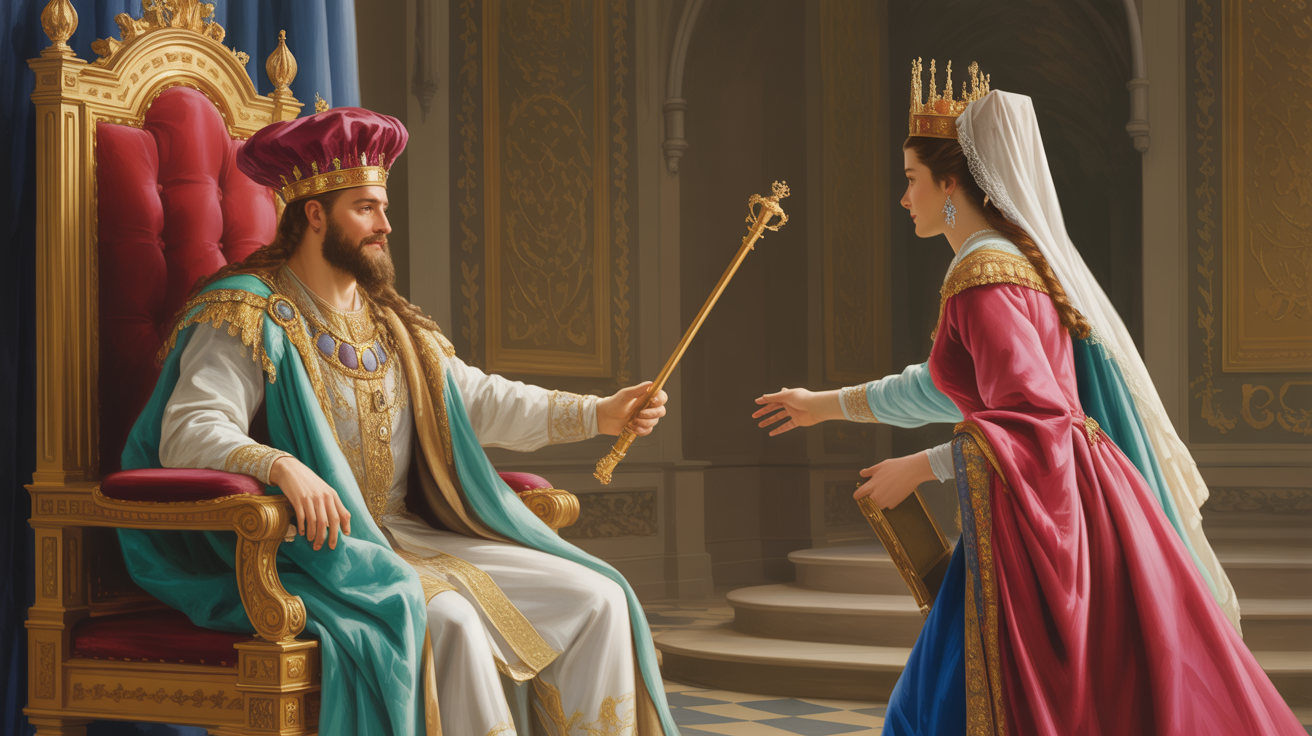
Before stepping into danger, Esther bowed beneath three days of fasting and prayer.
If I Perish, I Perish
Esther did not rush forward on emotion alone. She called for a fast.
She instructed Mordecai to gather all the Jews in Susa to fast for her — no food, no drink, three days and three nights — while she and her maids did the same.
Before she ever stood before the king, she bowed beneath the weight of her dependence on God.
Then she spoke one of the most courageous lines in all of Scripture.
"When this is done, I will go to the king, even though it is against the law. And if I perish, I perish." — Esther 4:16
That is not fearlessness. That is surrender.
True courage does not pretend death is impossible. True courage decides that obedience is worth more than safety.
Esther had reached the point where survival was no longer her highest goal. Faithfulness was.
The king extended the golden scepter, and Esther's life was spared.
The Golden Scepter
On the third day, Esther put on her royal robes.
Every detail must have felt heavy: the fabric against her skin, the silence in the hall, the distance between the door and the throne, the eyes of the court watching her step into a place she had not been invited.
She entered the inner court. The king saw her — and extended the golden scepter.
Her life was spared.
But Esther did not reveal everything at once. She moved with wisdom, inviting the king and Haman to a banquet. There, when the king offered her up to half the kingdom, she simply invited them to a second banquet the next day.
She was not stalling out of weakness. She was waiting for the right moment.

A sleepless night and a forgotten record set the reversal of the whole story in motion.
The Night the King Could Not Sleep
That same night, Haman's pride burned hotter still.
He had been invited to dine with the king and queen, yet seeing Mordecai still refusing to bow at the gate turned his joy into rage. At home, his wife and friends urged him to build a towering gallows for Mordecai.
So Haman prepared death for the man he hated.
But that night, the king could not sleep. He ordered the royal chronicles read aloud, and in them the servants found the record of Mordecai exposing the assassination plot against the king's life.
The king asked what honor Mordecai had received for it.
Nothing had been done.
Morning came, and Haman entered the court intending to request Mordecai's execution. Before he could speak, the king asked what should be done for the man the king delights to honor.
Haman assumed the king meant him, and described royal robes, a royal horse, and a public procession through the city.
Then the king commanded him to carry it out — for Mordecai.
The man who had built a gallows for Mordecai was made to lead him through the streets in honor.
The reversal had begun.
At the second banquet, Esther finally named the enemy threatening her people.
Esther Reveals the Enemy
At the second banquet, the king again asked Esther for her request.
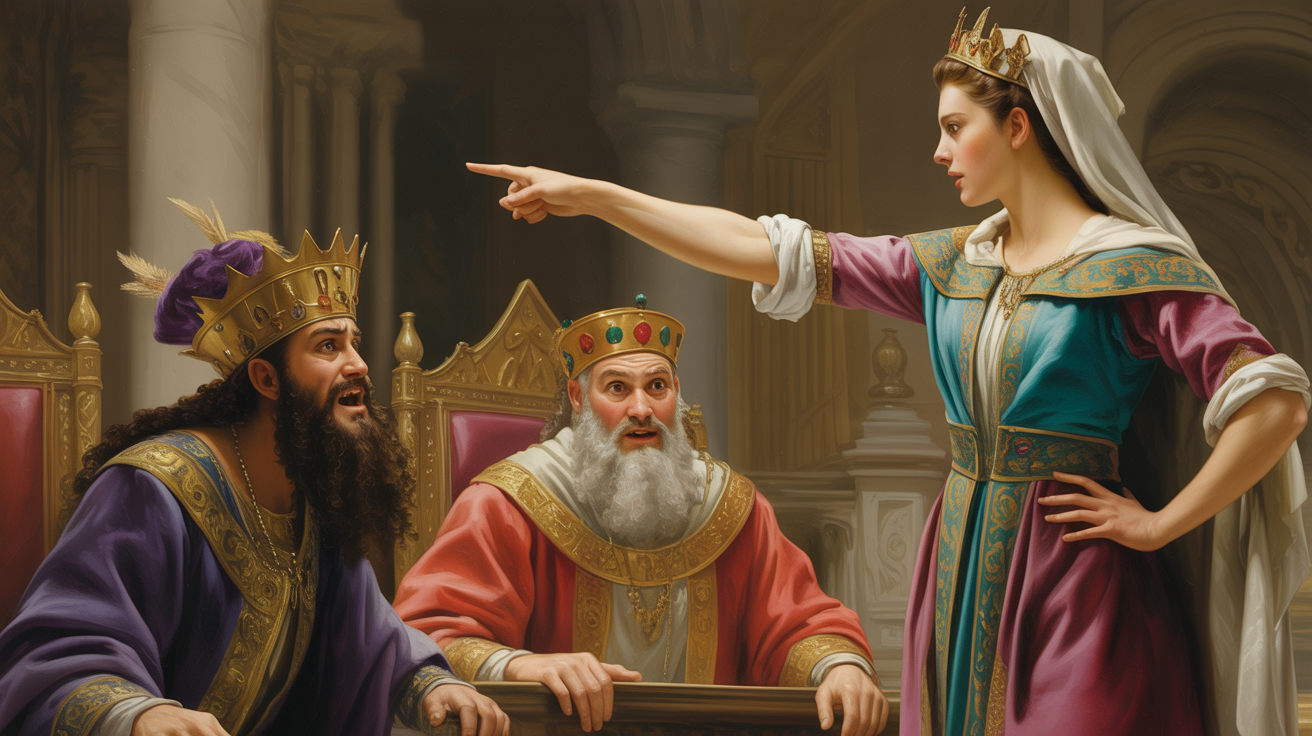
This time, she spoke. She did not hide behind her crown or speak in riddles. She laid her life and her people before the king plainly.
"For I and my people have been sold to be destroyed, killed and annihilated." — Esther 7:4
The king demanded to know who had done this. Esther answered with clarity.
"An adversary and enemy! This vile Haman!" — Esther 7:6
Haman's power collapsed in an instant. The king rose in wrath, Haman begged Esther for his life, and by the end of the day he was executed on the very gallows he had built for Mordecai.
The weapon prepared for the enemy became his own judgment.
A second decree turned the same empire that carried death into a messenger of deliverance.
The Decree Is Countered
Haman's death did not erase the decree he had written. A law sealed with the king's ring could not simply be revoked, and the appointed day of danger still loomed ahead.
So Esther pleaded again. The king gave Mordecai authority to write a new decree, allowing the Jews in every city to gather and defend their lives against those who attacked them.
The same empire that had once carried a message of death now carried a message of defense and hope.
When the appointed day finally arrived, the enemies of the Jews expected destruction. Instead, the tables turned. The Jewish people stood, fought, and survived.
What was meant to erase them became the day of their deliverance.
Purim still remembers the day mourning turned into gladness.
Why Purim Still Matters
This deliverance became the foundation for Purim, the Feast of Lots.
Haman cast the lot to choose a day of destruction. But the lot did not have the final word. The decree did not have the final word. Haman did not have the final word.
A story that began in hiddenness ended in remembrance. Letters were sent, days were established, and the people would forever remember how mourning turned to gladness and destruction was overturned.
Purim still carries that memory — survival, reversal, and the assurance that the people of God were never abandoned, even when heaven seemed silent on the page.
What This Means Today
Esther's story is not a call to chase influence for ourselves. It is a warning that influence carries purpose.
There are moments when silence feels safe, but faithfulness demands speech. Moments when comfort asks us to stay hidden, but obedience calls us to stand. Moments when God places someone in a position they never asked for — not to be admired, but to serve.
Esther did not know how the king would respond. She did not know whether the scepter would be extended. She did not know whether she would live to see her people delivered.
But she knew the moment had come.
And sometimes that is all courage requires: not a guarantee, but a calling.
Key Takeaways
- Esther's crown was not only a position; it became a place of responsibility.
- Mordecai's words, "for such a time as this," were not about comfort, but about costly obedience.
- The Book of Esther shows God's providence even though His name is never explicitly mentioned.
- Haman's plot reveals how pride and hatred can turn personal offense into widespread destruction.
- Esther's courage was shaped by fasting, wisdom, timing, and surrender.
- Purim remembers how a day meant for destruction became a day of deliverance.
Esther did not step into the throne room because she knew she would survive. She stepped forward because faithfulness had become greater than fear.
Final Thought
Esther's story still speaks because every generation faces moments when courage is costly.
Not every throne room looks like Persia. Not every decree is sealed with a king's ring. But there are still moments when truth needs a voice, when people need protection, when obedience requires risk, and when silence is no longer innocent.
Esther teaches us that God can work through hidden people, unlikely places, delayed timing, and dangerous doors.
And who knows whether the place you stand right now has been entrusted to you for such a time as this?
Support the Show
If this story moved you, consider supporting Kingdom Kutz Media so we can keep bringing scripture to life:
Follow Kingdom Kutz Media on social media:


Comments
Post a Comment